
What is sound?
Sound is vibrations that travel through the air or another medium and can be heard when they reach a person’s ear.
It can travel through a variety of different materials by bouncing off the molecules inside a material. This transfers kinetic energy from one molecule to the next as the sound wave travels through the material causing the molecules inside it to vibrate.
The amplitude of a sound wave is the height of the wave which determines how powerful or strong the wave is, this translates as the volume of the sound.
The Science behind the sound?
The low bass frequencies have a much longer wavelength than the high frequency waves so can move through materials more easily.
Sound waves are longitudinal types of waves, this mean they move in line with the wave’s energy. The frequency of the sound wave is how many oscillations occur within a given time, low frequency sounds have a longer wave length and as the frequency gets higher the wave length gets shorter, frequency is also related to pitch as the higher a frequency is then the higher the pitch is.
Sound Waves
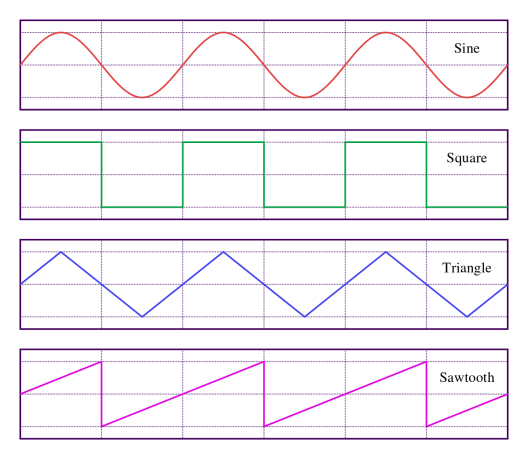
Some examples of basic wave forms are the sine wave which is a smooth repetitive oscillation, the square wave where the amplitude alternates at a steady frequency like a pulse between fixed minimum and maximum values. There is also the triangle wave which is easily recognisable due to the triangular shape of its waves and then there is the saw tooth wave form which is named because of the shape of the wave is like the teeth found on a saw, also the shape of the saw tooth wave gradually rises up then sharply drops off.
How do we measure sound?
In acoustics we use decibels as a unit of measurement to determine the volume of sound levels relative to a 0db reference. What we are actually measuring is the sound pressure which is the deviation from atmospheric pressure caused by a sound wave which as humans we perceive as the intensity or loudness of a particular sound. When you are recording sound try to make sure you have a “hot” signal level which means you have regular audio peaks between -6db to -3db.
The SPL Decibel Scale
The SPL decibel scale is the scale used to measure the intensity of sounds. The unit this is measured in is decibels (db.) The scale ranges from 0db, which is no sound at all to 140db, which is the threshold of pain from a sound being loud.
A few examples of sound level are 40db would be the average sound in someone’s living room, 85db is the average sound of street traffic, 100db is a pneumatic drill (jackhammer) and finally on the threshold of pain at 140db is an planes jet engine at a distance of 25m.
What are acoustics?
- A branch of physics concerned with the properties of sound.
- The properties or qualities of a physical space that determines how sound is transmitted in it.
- Acoustics is defined as the science that deals with the production, control, transmission, reception and effects of sound.
Most people think that acoustics is strictly musical or architectural in nature. While acoustics does include the study of musical instruments and architectural spaces, it also covers a vast range of topics, including: noise control, SONAR, ultrasound scans, seismology, bioacoustics, and electroacoustic communication.
The Relationship between Frequency and Wavelength
Frequency and Wavelength are very closely related. The higher the frequency the lower the wavelength. Because all sound waves move at the same speed, the number of wave crests that pass in one second depends on the wavelength. The frequency will also be larger for a short wavelength wave than for a long wavelength wave.
The Relationship between Frequency and Pitch
A high pitch sound corresponds to a high frequency while a low pitched sound corresponds to a low frequency. Here is a diagram for an example.
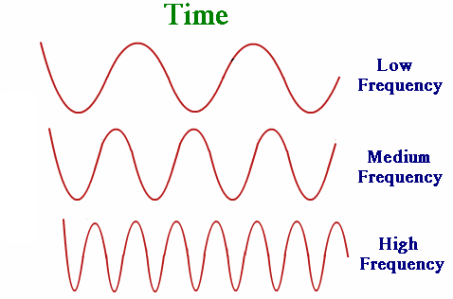

In basic terms a high pitch has a sharper tip (closer to triangle) than a low pitch which is more rounded and the frequency is the how close each wave is to each other.
Sound Proofing
The reason why people sound proof rooms while they are recording sounds is to get pure sounding audio with no background noise such as cars driving in the streets or other people walking around and talking in other rooms. Soundproofing also prevents sound from leaving the room and bothering other people in the house or the rooms next to wherever you are recording your instruments or dialogue etc.
What is the difference between Diffusion and Absorption?
Diffusion is where something is spread around widely around an area. So when that comes to sound and sound proofing, the sound being recorded will travel through the air and into the sound proofing foam which will then spread the sound around the room you are recording instead of it being released into other rooms. Absorption on the other hand absorbs the sound being made in the room so that I can not escape into any other rooms, but it also helps for the microphone to only pick up what you want it to pick up as every other sound thats not close to the mic almost gets absorbed by the sound proofing foam.
In the recording studio in Nantgarw college campus they have soundproof boards in a few spots on the ceiling to stop the music from travelling upwards into the classrooms above, they have sound proofing foam in the corners of the room as to spread the bass evenly around the area. However, the college has a problem, the room they placed all the recording equipment in has a large air conditioning unit in the ceiling which makes a lot of noise which affects recording dialogue and certain instruments.
 I'm a 90's Child...