Types of Employment
Freelance:
Freelance is the most flexible form of employment as you control when you work and when you have time off. If you don’t like a job offer that has come your way then you don’t have to accept it and can look for another. If you’re working for someone who you don’t particularly like, after you have finished that job with them you can decide yourself not to work with them again. Also if you have a family then as a Freelancer you can set you working times around you family. However, being a freelancer does come with its disadvantages. For example you don’t have a steady work flow and may go a few months without any work which means no money to fund your personal needs. Lack of benefits like payed vacations and health insurance.
Fixed Term:
With a Fixed Term employment you have the luxury of being paid like a permanent however you have to work there for a certain amount of time for example 6 to 12 months without being able to leave as you are contracted to that job. Also after your contract ends you may not be able to get another job with them and it does not guarantee a full time job afterwards.
Voluntary:
Volunteering is a great way to learn or develop a new skill that otherwise may be difficult to obtain. Keep in mind that it’s never too late to enhance your skill set.
Permanent:
Pros
- Maintain set work hours and/or work schedule.
- Less financial risk due to receiving a regular pay check.
- Maintain a continued expectation of work.
- Employer typically provides paid time off, vacation time, and/or holiday pay.
- Income taxes are deducted from pay check.
- Might receive additional employer incentives or benefits, such as bonuses.
Cons
- Typically have a daily commute to an office.
- Only have a limited number of days off per year.
- Provided with a limited scope of work.
- Might not have the ability to branch out and try different types of work.
- Less freedom to decide one’s own schedule.
- Less opportunity to negotiate pay rates.
Wales has been a large contributing country to the TV and Film industry because of our wonderful landscapes, its not just that though we also have a few world class studios and a history of producing television shows that appeal to a large variety of audiences for example Doctor Who which is the longest-running science fiction television show.
There are 53,000 people who are employed in the creative industries in wales however there are many skills gaps. For example there are skill gaps in the Welsh Language, technical skills, sales and marketing and especially in VFX.
The career paths I have chosen are:
- Film Director
- Camera Operator
- Screen Writer
Film Director
A Director is the main body of any film or television show. The Directors work very closely with producers and the screenwriters to make someones idea and dream have a visual representation. Directors needs to understand the significance of scenes and how to shoot them. Directors also have the power to change the structure of a scene or even make a directors version of the script to change the pace or to create dramatic tension. The directors version of the script is also what all crew members work off of. Directors are responsible for both the creative and technical aspects of the production where they work to the projects budget, keeping the production under control and creating a safe and creative environment for the crew and actors.
Skills needed to be a director:
- Ability to form ideas and to think visually.
- Ability to create a clear and creative style for the production.
- Great attention to detail.
- Very methodical and calm when it comes to working in a high stress environment.
- Knowledge with the entire production process.
- Excellent verbal and written communication skills.
- Able to lead and motivate their actors and crew.
- They must have initiative and problem-solving.
- Able to see the broader picture and meaning.
- Ability to have diplomacy and sensitivity when it comes to working with writers, producers, actors and crew members.
- Knowledge of health and safety procedures.
Camera Operator
Camera Operators follow the DoP (Director of Photography) and the Director with shot compositions and they are responsible for all the aspects of camera operation and the preparation for the shoot. Its important for camera operators to keep watching and analysing new Television shows and Films to keep up to date with trends and styles of the modern media. Also many camera operators will develop additional skills such as using a steadicam, aerial shots and underwater experience to improve employ ability.
The skills needed to be a camera operator are:
- Need to have an artistic vision.
- Strong creativity and attention to detail.
- Have an eye when it comes to colour and lighting.
- Good technical knowledge of digital processes and camera equipment.
- Knowledge of photography, painting and of moving image.
- Physical coordination and strength.
- Having the ability to accept and give direction.
- Excellent communication skills.
- Knowledge of relevant health and safety procedures.
Screenwriter or Scriptwriter
Screenwriters provide a blueprint which the producers, director, production designers, composers and editors, cast and crew use to make an idea be able to turn into a visual and where a reader can see it cinematically. The screenplay does not only have fascinating characters it must also have an exciting plot with a great premise for a marketable film however, it must have logical principles and a dramatic construction, as well as a industry format and style. Screenwriters must produce a highly creative screenplay with originality.
Skills a Screenwriter/Scriptwriter needs:
- A strong understanding of film narrative, and knowledge of different audiences tastes and trends from the past and future.
- A passion for cinema and film making.
- Ability to search out new types of talent and creative relationships.
- Excellent all-round communication skills.
- Able to sort out story problems using creativity, discretion and great flexibility.
- Keen insight into all aspects of screenplay tones, genre, style, structure, character, plot, action and dialogue.
- An understanding of development for example log lines, premises, synopses, beat outlines, step outlines, treatments and rough drafts.
- A strong understanding of how to use dramatist’s tools such as comic irony, suspense, mystery and dramatic tension.
When it comes to choosing only one career path I find it very difficult to do that. The reason why that is comes from me being used to doing everything when I have created short films in the past, I created the scripts and storyboards, I directed the production, acted in some of them and then did all the post production and posted them on my YouTube channel. Originally I wanted to be an actor but then I grew a strong passion in photography and creating short films and animations and my dream of becoming an actor faded away and I wanted to ‘make my own films’ however, before I joined this course I did not realise how hard it really is to make your own films yourself. Really I’d primarily want to be an auteur, for example Quentin Tarantino the creator of amazing films such as Kill Bill, Pulp Fiction, Django Unchained, Reservoir Dogs and many more is not just the director, he writes the scripts, directs the actors, probably operates the camera and he also acts in a few and that is what I hopefully will do but I do understand it is very rare to have that chance.
So when it comes to figuring out what career path I want to do I would say that I would choose being a director however when it comes to university I have an idea. My idea is to study in a directing course for how many years, then after that study on a course for script writing, then camera operating and finally post production editing. Now I understand that doing that will have me be in university for 6 years or even more, but I believe that doing that will give me more of a chance at getting more jobs and starting a career as an auteur like I want to and have full creative control of films I want to make. Granted I will not be able to be an auteur straight after I have finished college and I will have to publish my own scripts to producers, directing someone else’s film idea or be an editor for someones production, but doing that will allow me to progress in reaching my goal and getting the career I want.
These are some of the different careers in the creative industries and how much you can earn from them:
Animator: £15,000 – £40,000
Web Designer: £18,000 – £30,000
Graphic Designer: £18,000 – £35,000
Illustrator: £18,000 – £40,000
Editor: £19,000 – £38,000
Video Maker/Producer £23,500 – £50,500
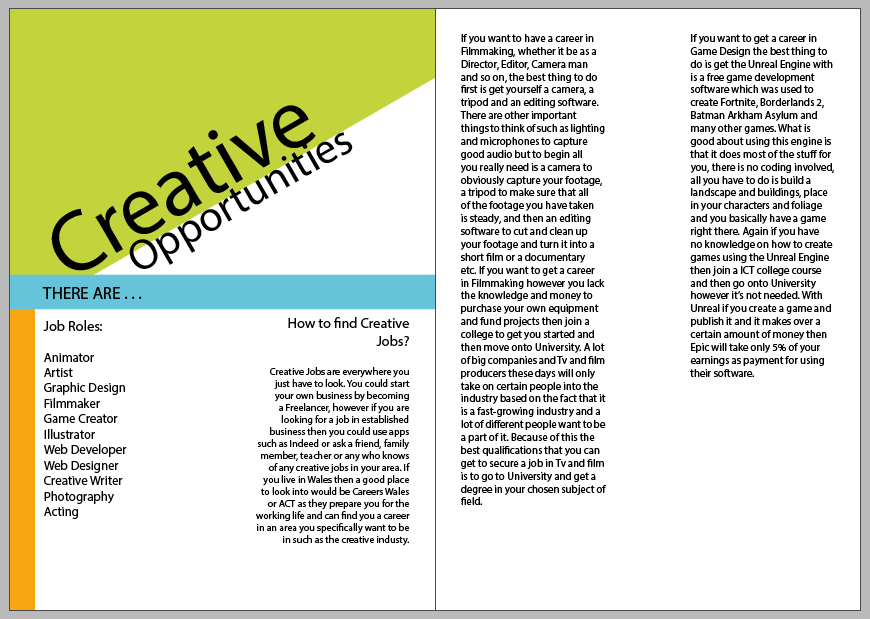
Here is a piece I created on InDesign which shows Creative Opportunities and how to get there.
I have been tasked to create a business card for myself which will be shown at the end of year exhibition. This task is great, not only does it go towards my grades and is a smooth and quite simple task, but it also helps me put myself out into the world and will help me start a business of my own. I scoured Pinterest in search of ideas for my own design and found a few that I liked.
What is a business card you may ask. A business card is another form of a personal identification except as you can guess by its name it is an identification for your business and it also shows simply who you are, what you do and it also shows of your style and skills on a small piece of card.
With the advancement of Social Media and the Internet you’d believe that business cards would have fallen out of popularity and use, but on the contrary business cards are still in high use

Even though I do not usually go for just plain black and white I feel like it does work here. The artwork on the front of the business card is good as it shows you straight away that Nick Patton is an artist.

I love the colour palette that this business uses and I love the way the text fades which goes well with what the text says: “Time Passes by” as it symbolises the passing of time.
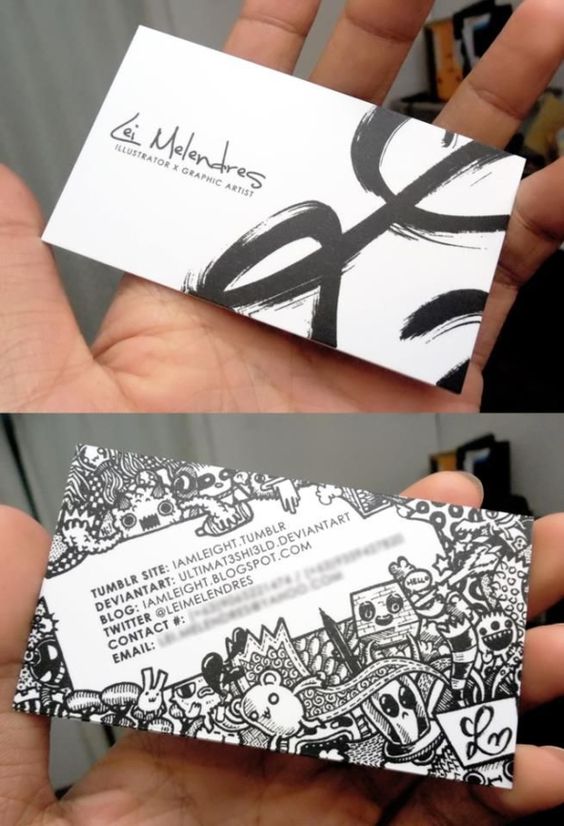
With this business card I only really like the cartoon designs on the back, I love the style.
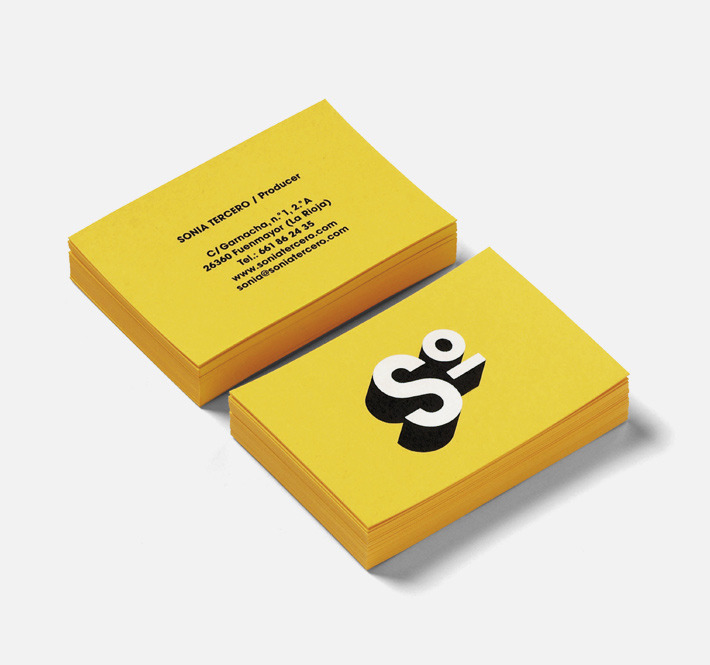
Minimalistic, yellow, bold text with a drop shadow, what more could you ask for in a design. However just by looking at it without reading it you wouldn’t know what the profession of the person is as there is no indication of it in the design.
I prefer the minimalistic style as I feel that when there is a lot on the page, card whatever that it distracts the viewers eyes and they do not take in the information that needs to be taken in or the information that you want them to take in. However I do feel that having just a plain black and white business card is boring as there is no vibrance to it and black and white is used too often so people will just see it as another business card, there is no creativity. I feel it is best to have some sort of colour in your graphic work however, black and white does work in some instances. Here are some colour palettes that I like.

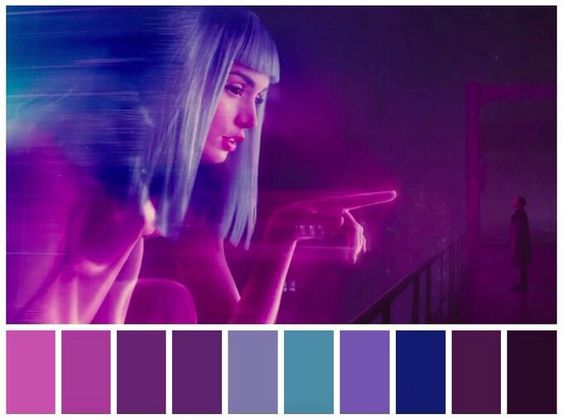
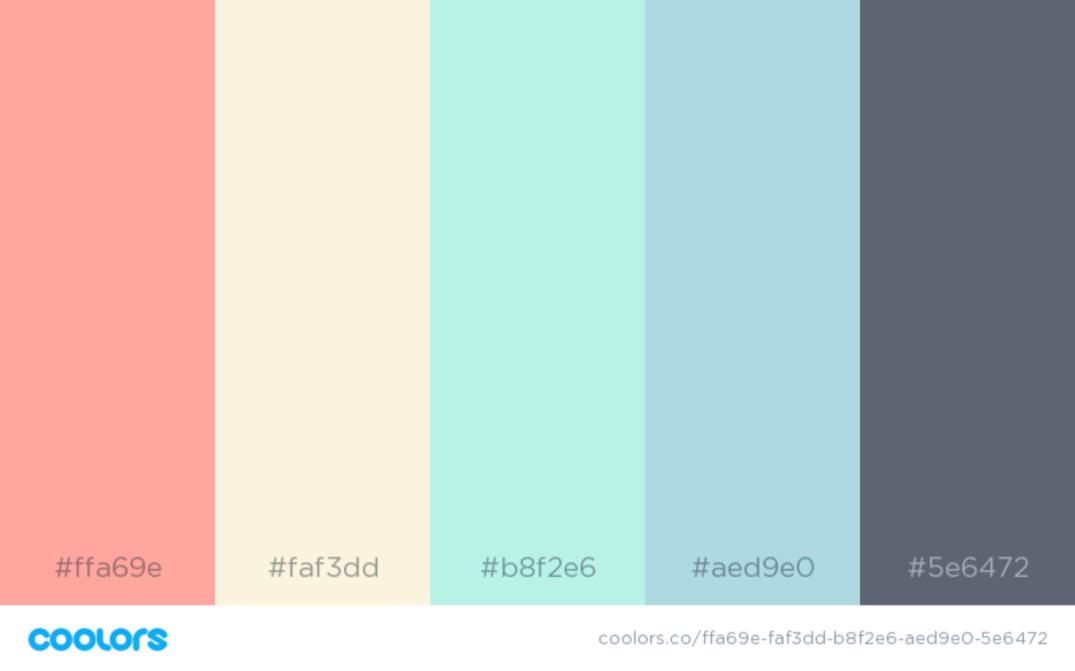
I like these colours as they are a mix of pastels and dark but also vibrant pinks and blues. I love the aesthetic of pinks and blues and those are the colours I am going to use in my business when I begin to create it.
When it came to choosing a font for my first business card design, I choose these two:


I then decided to use a background full of cacti as I love cacti. I also used a background I took of google which was covered in different Cacti. However recently I have lost my motivation to do anything and it showed in my work and my tutor was very upset with what I had created and told me that I could do so much better, I kicked my arse into gear and decided to start from scratch. I decided to sketch up a character I had created for a friend once, scanned him into photoshop and then outlined him and coloured him. Afterwards then I placed him into Illustrator and looked for fonts to use. As the text on the characters top was handwritten I decided to find a text similar which was this:

For the text underneath my name then I decided to use the font I had use on my previous design Hai Eisya. I do not usually like using two different fonts however in this case I liked the way it looked.
I then coloured the back on the business in the same colour as the characters top and placed my email at the bottom in the Lemon Yellow Sun font and this is what the completed business card looks like:


To conclude I did found this project very difficult as I am not that interested in graphic design and that is why I had such low motivation to complete it, but I realised recently that in life the things you want to do don’t come to you, you have to chase after them and work hard for them. You’re not going to walk down the street one day and have someone walk up to you and ask you to do things for them, you have to get you talent noticed by putting yourself out there, and when it comes to making a film for example there are going to be things you’re not going to like, for example you can’t just go out and shoot a film, in a perfect world maybe but in this world you need to do lots of paperwork, scripts, storyboards, animatics, proposal, healthy and safety form, shot lists, location scouting lists, editing list and these are things you have to complete before you even begin filming. So I am glad I have done this work in a way as it has made me realise that do all the boring paperwork has to be done to ensure you can create your master piece and now I also have something to use to present myself as an individual and to promote what I do. Also I believe that this business card is different to the usual stereotype of a business card and will have people remember it more.
 I'm a 90's Child...